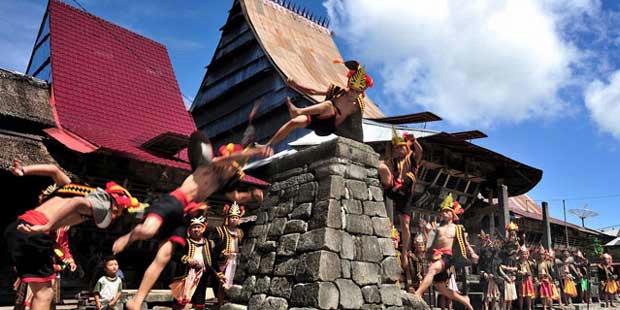
Visited the village in Nias Bawomataluo


Bawomataluo village is already registered on the UNESCO World Heritage since 2009 as a cultural heritage of Indonesia. This village is a traditional village culture as well as a well-known village in South Nias regency, North Sumatra. To reach this, necessary for 3-hour road trip from Mount Sitoli heading south coast of Nias.

In the language of Nias, Bawomataluo means hill sun. So named because the village is located at an altitude of 400 meters on the hill. In the village the air is cool, we can see many traditional houses in South Nias were still awake.

Apparently Bawomataluo Village is the capital of indigenous villages are scattered in Nias. It is said that this village has existed since the time of megaliths. Relic that we can see from an ancient building and a large rock in one of the traditional King Nias is here.

Another uniqueness, this village looks like a flat piece of land with stones wide, filled with rows of houses facing each other. From the steps of the village, we can immediately see a row of houses. Among the residents of the house, the home of King Nias is located on the left. While the indigenous inhabitants of houses and a community hall on the right.

Although centuries old, the buildings are still intact and well preserved. The buildings were never renovated except roof that was replaced with zinc to make it more durable.

Travelers are free to enter the village. However, we must first report to the chairman of the local customs. From there we will describe the history of the indigenous villages. No special restrictions while visiting this village, besides asking for permission and dress modestly.

kompas

Comments

Post a Comment

Popular posts from this blog

ORIGIN AND HISTORY OF THE KERIS

The most famous pusaka or heirloom for Javanese people is Keris (dagger). In the ancient time, a man is not considered as a real man if he has no keris. The keris is highly valued, treated and respected with special care. This pusaka is usually inherited from fore fathers. According to Javanese ancient tradition, especially in the court families, a father was obliged to give to his adult son at least a keris. In general, keris is divided to two important parts, the blade (Wilah) and the scabbard (Warangka), to protect the blade. The process of the making of the blade in the old days may last one year only for one keris. The keris maker is called an Empu. Only the respectable Empus could make a high quality keris, physically and spiritually. Empu has to do some spiritual deeds to prepare a keris, like fasting, not sleeping for several days and nights, meditation, etc. In Principle, a keris is a personal sacred weapon, it is made by an Empu, in accordance with the wish of the consum...

Customs Cloth Lampung Province

Lampung is the southernmost province on the island of Sumatra. Its location adjacent to Java Island made Lampung in the past became one of the transmigration destination of Java's population. This causes the inhabitants of this province to be very heterogeneous. There are many tribes who live in this province, among them the tribe of Java, Sundanese, Bali, and Lampung own tribe. Custom Clothes Lampung Despite having a population of heterogeneous tribes, the indigenous culture of Lampung itself is still sustainable. One of the cultural heritage that we can still often see is the traditional clothes of Lampung. Traditional clothing Lampung Lampung is a cultural heritage that is very distinctive and has a high artistic value. Traditional clothing is often used by the bride as a symbol of cultural greatness Lampung. This outfit is also sometimes used in dance performances in the Lampung area, such as dance worship, dance bedana, and so forth. Custom Clothes Mal...

Traditional Clothes of West Papua

Traditional clothes of men and women in Papua physically you might conclude that these clothes are similar. They wear clothes and body cover the bottom with the same model. They also both wearing the same ornaments, such as a headdress in the form of birds of paradise, bracelets, necklaces, and belts of beads and fringe at the ankle. Forms of dress depicted here is a new creation. Customarily not forget to spears / arrows and shields held the groom give the impression of indigenous Papuans. Apparel Wedding Bride Wedding attire worn by the bride is in white dress, red-brown. Papuans did please the white color in the dress, it is a development that goes hand in hand with time. Although they still love the vibrant colors and patterns typical of Papua, such as beads or bird of paradise plumes. The combination of colors used symbolized by the color hue birds of paradise feathers. Indigenous Elders and Religious Clothing Imposed by traditional elders and religion are...