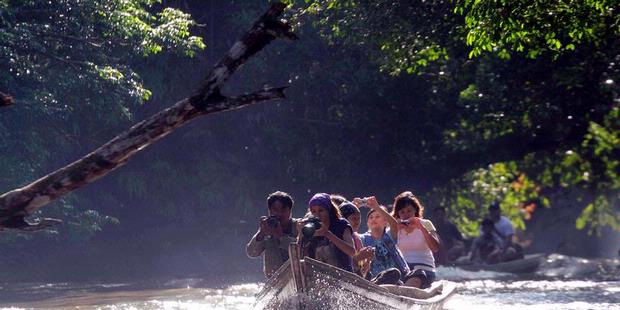
Ecotourism Potential Tessonilo High Enough


Tesso Nilo National Park (TNTN) in Riau Province has ecotourism potential is quite high with the number of tourist visits an average of 900 people each year.

"If calculated per year, visits to Tessonilo numbered approximately 800 to 900 people per year," said Public Relations Program WWF Riau, Pekanbaru Syamsidar on Tuesday (08/01/2013).

He said the ecotourism TNTN now managed jointly by the Institute under the Ministry of Forestry TNTN, and by the Group of Community Care Services (Kempas). Since Kempas established in October 2010 to date has facilitated many guests from abroad by about 450 people.

Foreign travelers who've been to TNTN recorded from Sweden, Singapore, United Kingdom and Germany.

"Ecotourism positive impact on both sides, both for the development of ecotourism Tessonilo and to the surrounding community because it provides additional income, though still limited because of a new beginning," he said.

Attention of government to the community also began to appear in 2012. Department of Culture and Tourism Pelalawan provide funding of USD 75 million for the purchase of boats pompong, business souvenirs, clothes organizations, increased community arts and manufacturing outlets for businesses Kempas.

Head of TNTN, Kupin Simbolon said, there is still a lot that needs to be addressed for the development of ecotourism in the conservation area. In addition to lacking adequate infrastructure, a threat to the development of ecotourism potential TNTN come from the eroding forest encroachers.

 In fact, continued Simbolon, encroachment of forests destroyed not only ecological but also threatens the survival of wildlife in TNTN such as Sumatran elephants, tigers and monkeys.

"Disruption of encroachment of forest to oil palm plantations makes us not too focused on the development of ecotourism TNTN. Therefore all parties should stand together hand in hand to build the promotion, improvement of facilities and accessibility," he said.

During this TNTN ecotourism offers a number of tour packages such as through the forest, boating on a river patrol with elephants Flying Squad team, and harvesting honey Sialang forests sustainably.

"If it could be developed further homestay in people's homes, but it needs support from other regions as well as Tessonilo be in a number of areas that Pelalawan, Indragiri Hulu and Kuantan Singingi," he said.

kompas


Comments

Popular posts from this blog

ORIGIN AND HISTORY OF THE KERIS

The most famous pusaka or heirloom for Javanese people is Keris (dagger). In the ancient time, a man is not considered as a real man if he has no keris. The keris is highly valued, treated and respected with special care. This pusaka is usually inherited from fore fathers. According to Javanese ancient tradition, especially in the court families, a father was obliged to give to his adult son at least a keris. In general, keris is divided to two important parts, the blade (Wilah) and the scabbard (Warangka), to protect the blade. The process of the making of the blade in the old days may last one year only for one keris. The keris maker is called an Empu. Only the respectable Empus could make a high quality keris, physically and spiritually. Empu has to do some spiritual deeds to prepare a keris, like fasting, not sleeping for several days and nights, meditation, etc. In Principle, a keris is a personal sacred weapon, it is made by an Empu, in accordance with the wish of the consum...

Jambi Traditional Clothes

A. Jambi Traditional Clothes Jambi is the designation for the people who inhabit the area along the river Batang Hari, Jambi province. In the women dressed daily at first only known with a cloth and a sleeveless shirt. While the men wore trousers and a half wide in the field of his calf and usually black, so that more freedom of motion in performing activities of daily activities. Clothing for men is equipped with a cap as a head cover. In the next development known as the traditional clothes. Custom clothing is more luxurious than everyday clothes are decorated with gold thread embroidery and the use of jewelry as a complement. B. Custom Men Clothing Men Jambi tribe in traditional dress to wear in head.Lacak track is made of: red velvet cloth that was given in dalammnya thick paper for making it hard. Headgear has a towering two parts, with a higher julangan on the front. For decoration there were paintings of flora from the leaves, flower stalks that will bloom clan. The edge of the ...

Customs Cloth Lampung Province

Lampung is the southernmost province on the island of Sumatra. Its location adjacent to Java Island made Lampung in the past became one of the transmigration destination of Java's population. This causes the inhabitants of this province to be very heterogeneous. There are many tribes who live in this province, among them the tribe of Java, Sundanese, Bali, and Lampung own tribe. Custom Clothes Lampung Despite having a population of heterogeneous tribes, the indigenous culture of Lampung itself is still sustainable. One of the cultural heritage that we can still often see is the traditional clothes of Lampung. Traditional clothing Lampung Lampung is a cultural heritage that is very distinctive and has a high artistic value. Traditional clothing is often used by the bride as a symbol of cultural greatness Lampung. This outfit is also sometimes used in dance performances in the Lampung area, such as dance worship, dance bedana, and so forth. Custom Clothes Mal...